
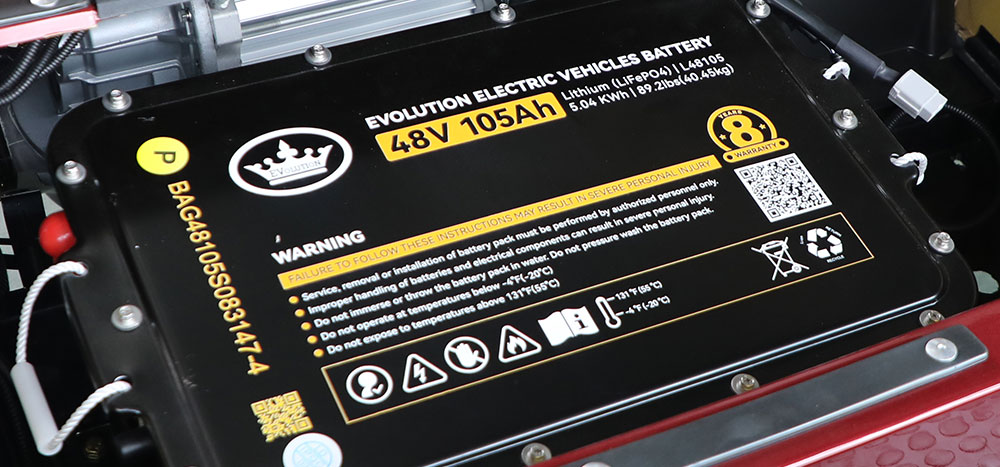

In the world of EVOLUTION, true progression isn’t just about new models—it’s about the chemistry and innovation powering what comes next. And at the center of that revolution? Lithium batteries

Not Just Power—Possibility
Lithium batteries didn’t just extend performance—they fueled a full reinvention. Golf cars have evolved into mobile tech hubs, off-road explorers, neighborhood rovers and lifestyle platforms in their own right. All rendered sustainable by the weight-saving and power-dense advantages of lithium chemistry.
But the real magic of lithium isn’t in the battery alone—it lies in what it enables. Not only about better mileage or faster charging. Lithium spared weight, eliminated maintenance headaches and eliminating voltage sag, lithium technology unlocks high-tech enhancements once relegated to full-sized EVs. Now, golf cars boast wire/wireless charging, three-point seatbelt, 4WD, EPS and modular designs for cargo or passengers.
The Roots of Lithium-Ion: A Legacy of Innovation
Lithium-ion batteries trace their origins to mid-20th-century breakthroughs. The early trailblazer was M. Stanley Whittingham, who in the 1970s developed a rechargeable prototype using titanium disulfide as a cathode.
That innovation laid the foundation for John Goodenough’s later replacement of cathode materials with lithium cobalt oxide, offering improved voltage and stability.
Then came Akira Yoshino’s safer, graphitic-carbon anode design, culminating in the first commercial lithium-ion battery by Sony in 1991.
What these pioneers created is the lifeblood of our smartphone-dominant era—and, more recently, the EV revolution.
Each of these innovations holds potential to redefine speed, range, and usability.
Beyond Distance
Lithium batteries excel not merely in range but in sustained reliability. A typical lithium-powered golf car can travel three times farther than a lead-acid model and maintain stable power output from full to empty. Meanwhile, quality lithium packs can last over a decade—up to five times longer than lead-acid variants.
Their rapid charge time—roughly 4–6 hours versus the 8–12 hours required for lead-acid—reduces downtime dramatically. And with no need to top off water or counter corrosion issues, lithium batteries deliver a nearly maintenance-free experience.
Evolution: A Bright Road Ahead
Evolution didn’t just stop at electrifying its carts,they evolved the entire concept. Evolution’s integration of lithium batteries fundamentally altered the DNA of golf carts. By embracing lithium-ion, it elevated carts into high-performance, low-maintenance platforms decked out with tech features once reserved for high-end EVs.
The D5 series and D-MAX series, packaged with premium leather seats, touchscreen with integrated infotainment, advanced lighting, and, of course, lithium performance. Designed for everything from resort shuttling to off-road exploring, these models expanded the utility and the cool factor of what a golf cart can be.
☑️Lithium is more than chemistry—it’s catalyst.
☑️Performance, design, and tech converge around battery evolution.
☑️New chemistries and sustainable extraction are charting a clean-energy future.
The Future: Continuously Energized Progress
Looking ahead, as battery tech continues to evolve and recycling infrastructure expands, Evolution and the broader golf-cart and small-EV space stands to benefit from smarter, more efficient, and more sustainable energy solutions.
From their scientific beginnings to powering futuristic lifestyles, lithium batteries have sparked an evolution. EVOLUTION, as a brand, stands to embody this narrative—evolving alongside the chemistry itself.