
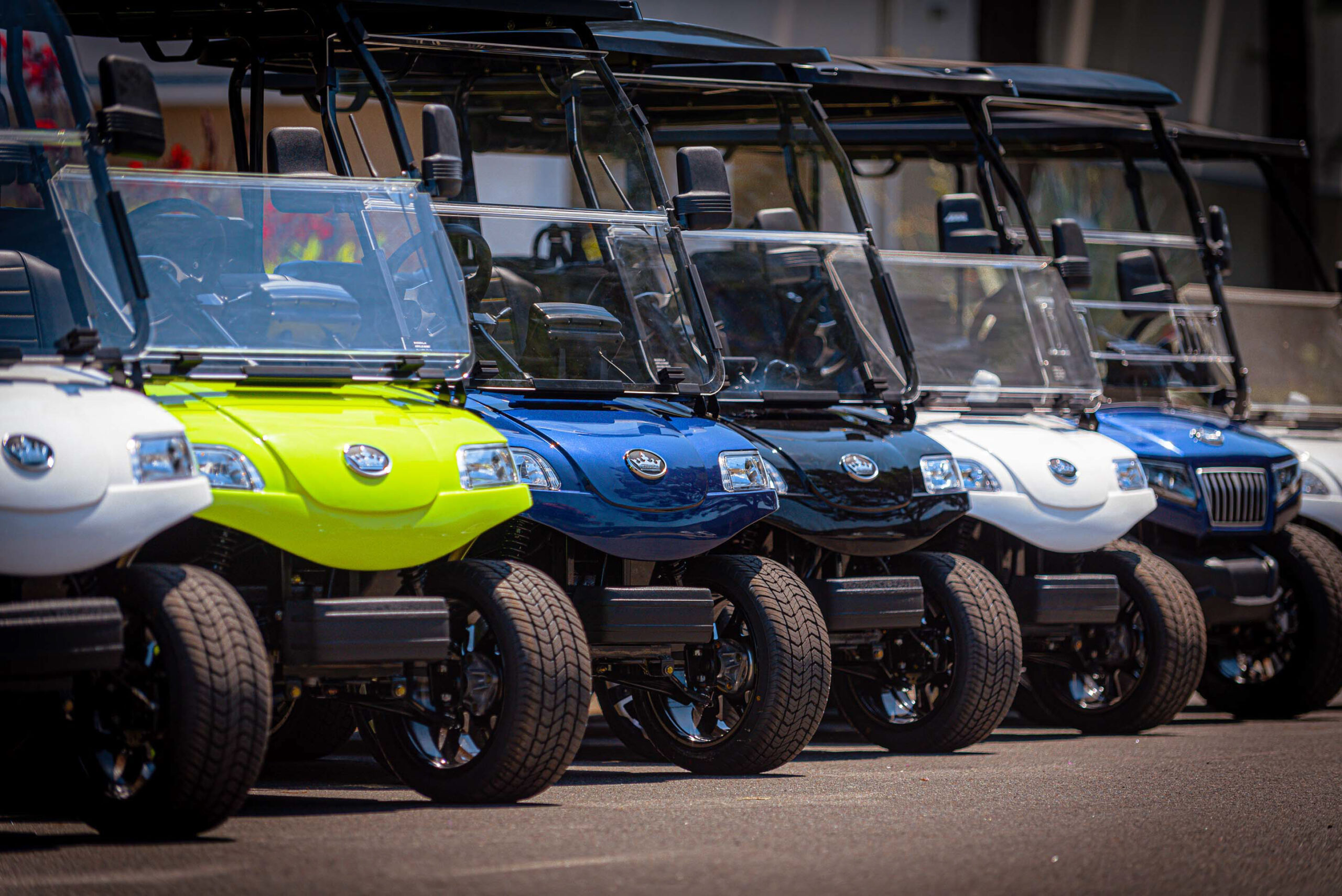

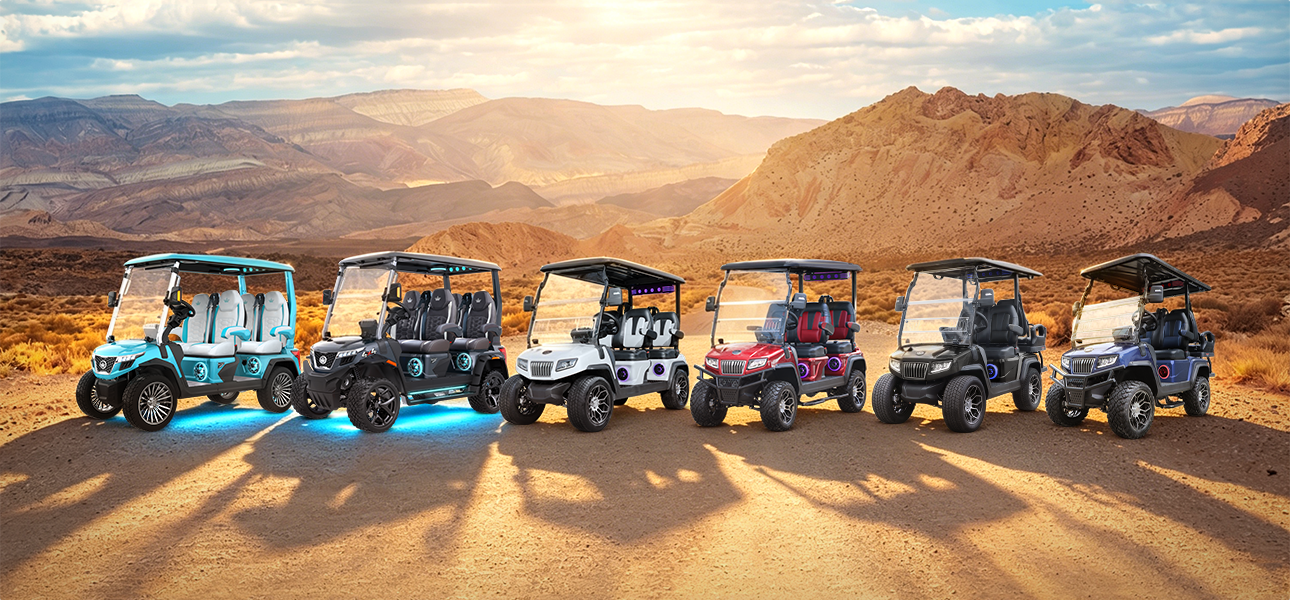
LSVs and Golf Carts are becoming increasingly popular for short-distance transportation in communities across the United States. Once associated primarily with golf courses and retirement communities, today’s Golf Carts and LSVs are evolving into practical personal vehicles for neighborhood travel, school runs, shopping, dining, recreation, and other everyday trips close to home. This report explores the trends behind this shift and why more consumers are considering smaller electric vehicles as an alternative to conventional cars for short trips.
Beyond the Course. An Trending Alternative of Consumer Cars for Short Distance Trips
Why LSVs and Golf Carts Are Becoming an Alternative for Short Trips?
Executive Summary
The U.S. golf cart market is undergoing a fundamental change.
Historically, golf carts were designed primarily for golf courses. A significant portion of the consumer market developed around used fleet vehicles that were retired from golf courses, refurbished by dealers, and resold for private use.
That model still exists, but it no longer adequately describes the market.
A new generation of purpose-built personal transportation vehicles (PTVs) and low-speed vehicles (LSVs) is increasingly being purchased new by consumers—not necessarily to play golf, but to transport families, visit neighbors, reach community amenities, go to restaurants, make short shopping trips, and handle other everyday transportation.
The underlying opportunity is substantial. According to the Federal Highway Administration’s analysis of the 2022 National Household Travel Survey, 46% of U.S. personal-vehicle trips are less than 5 miles, while 69% are less than 10 miles.
In other words, a large majority of American vehicle trips are relatively short.
At the same time, approximately 58% of U.S. households have two or more vehicles available, according to recent Census and FHWA data. U.S. Department of Energy analysis also shows that within multi-vehicle households, secondary vehicles are typically driven substantially fewer miles than the primary vehicle.
These trends create a compelling question for consumers:
Does every short trip require a full-size automobile?
Increasingly, the answer may be no.
From Golf Equipment to Personal Mobility
The traditional golf cart was designed around a very specific task:
Transport two golfers and their equipment around a golf course.
That purpose shaped virtually every aspect of the product—seating, storage, speed, suspension, styling and features.
Private ownership initially grew largely as an extension of this market. Golf courses periodically retired fleet vehicles, dealers refurbished them, and consumers discovered that inexpensive used golf carts could also be useful around neighborhoods, retirement communities, resorts and private properties.
The new market is different.
Consumers are increasingly purchasing new vehicles designed from the beginning for personal transportation.
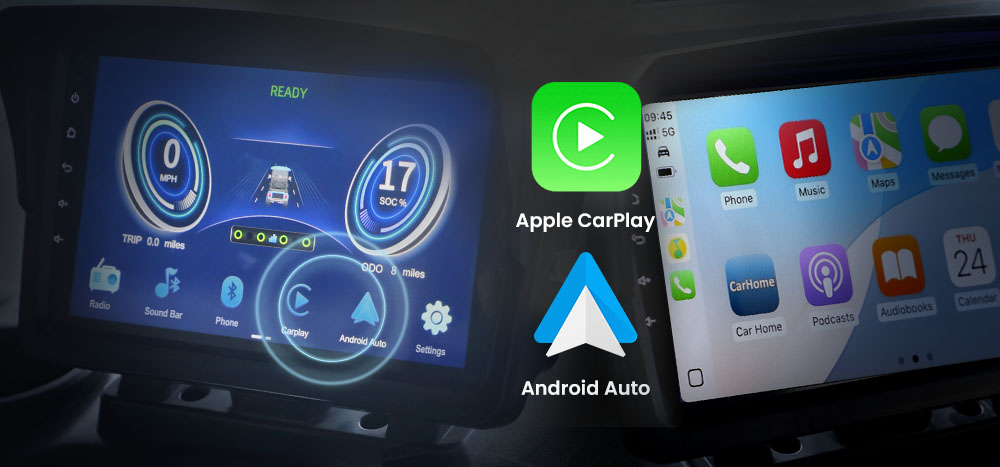
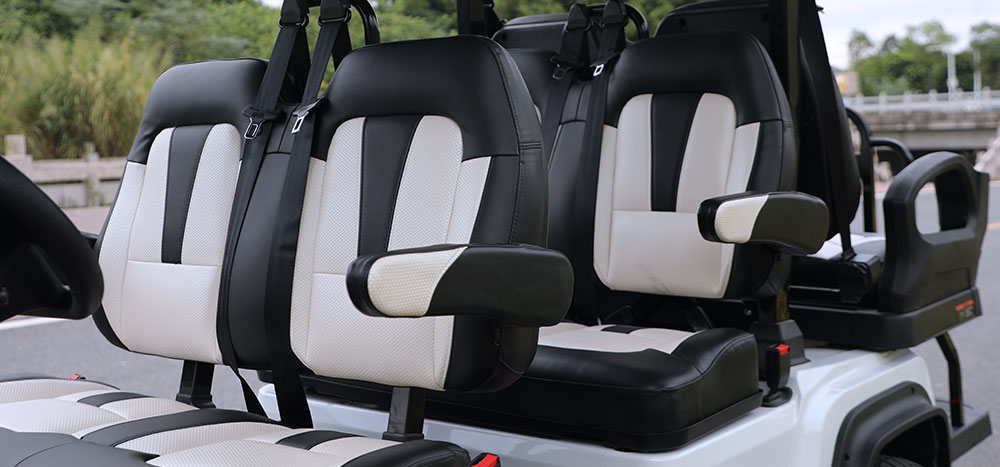
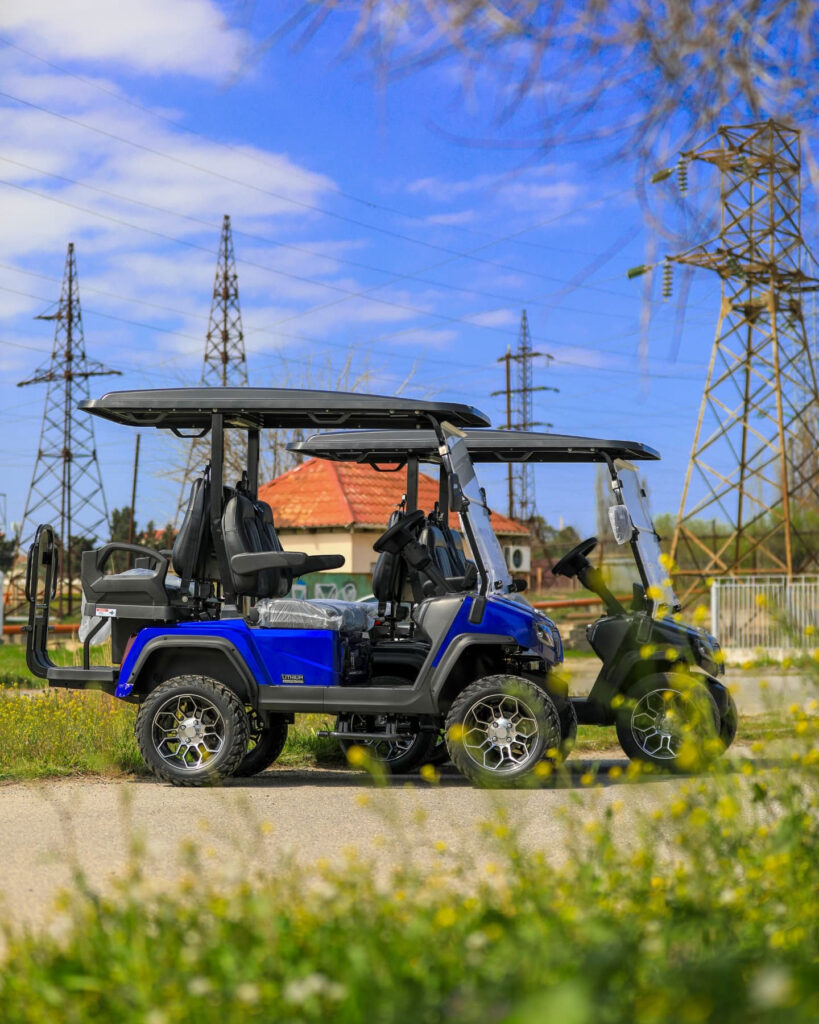
Modern PTVs and LSVs commonly offer four or six seats, forward-facing passenger configurations, lithium batteries, automotive lighting, seat belts, mirrors, cameras, large displays, premium seating, sophisticated sound systems, phone connectivity, refrigerators or coolers, and significantly more cargo capacity.
These features are difficult to explain purely through the needs of golfers.
They make considerably more sense when the vehicle is understood as a small personal vehicle for everyday life.
Most Everyday Driving Is Surprisingly Short
The strongest argument for neighborhood electric mobility comes from how Americans actually use their automobiles.
Federal Highway Administration data based on the National Household Travel Survey shows:
- 16% of personal-vehicle trips are 1 mile or less
- 46% are less than 5 miles
- 69% are less than 10 miles
That means nearly seven out of every ten personal-vehicle trips occur within a distance that may potentially be compatible with neighborhood-scale transportation, depending on road speeds, infrastructure, regulations and vehicle classification.
Of course, a golf cart or LSV cannot replace every automobile trip.
Highways, long commutes, severe weather, high-speed roads and long-distance travel still require conventional automobiles.
But an LSV does not need to replace the primary family car to create significant value.
It only needs to replace a portion of the household’s short trips.
Consider the everyday destinations surrounding many American communities:
Home → school
Home → community pool
Home → restaurant
Home → grocery store
Home → gym
Home → friend’s house
Home → clubhouse
Home → beach or marina
When these destinations are only a few miles away and accessible through low-speed streets, using a 4,000–6,000-pound automobile for every trip may be unnecessary.
A smaller electric vehicle can provide a simpler alternative.
The Second Car Is the Greater Opportunity
The most realistic opportunity is therefore not replacing America’s primary automobiles.
It is reducing dependence on the second car.
Approximately 58% of U.S. households have two or more vehicles available.
Federal energy data also shows that vehicles within the same household are not used equally. The second vehicle in multi-vehicle households is driven considerably fewer daily miles than the primary vehicle.
That creates a natural role for a PTV or LSV.
A household might still maintain a conventional automobile for commuting, highways, long-distance travel and adverse weather while using a smaller electric vehicle for routine neighborhood transportation.
The consumer proposition therefore changes from:
“Replace your car with a golf cart.”
to:
“Why use your car for every three-mile trip?”
That is a considerably broader and more practical proposition.
Families Are Becoming Part of the Market
Another important development is the expansion of golf-cart transportation beyond retirement communities.
Recent reporting on master-planned communities documents golf carts being used for school drop-offs, visiting neighbors, accessing community amenities and other everyday family activities.
This helps explain why larger configurations are becoming increasingly important.
A traditional two-seat golf cart works well for two golfers.
A neighborhood family may need:
four forward-facing seats, six-passenger capacity, storage for backpacks, groceries and personal belongings, cupholders, charging ports, entertainment, weather protection and safety equipment.
The changing product itself therefore provides evidence of the changing use case.
Manufacturers are no longer simply adding features to golf carts.
They are designing vehicles around a different lifestyle.
Master-Planned Communities Create an Ideal Environment
The growth of master-planned communities may further accelerate this trend.
Many such communities combine residential neighborhoods with schools, pools, clubhouses, parks, restaurants, shopping and recreational amenities.
When these destinations are connected through low-speed local roads or dedicated paths, residents can complete a significant portion of everyday activities without leaving the immediate community.
Recent research on leading U.S. master-planned communities also shows a strong geographic concentration in states such as Florida and Texas, where warmer climates make year-round use of small personal vehicles more practical.
These communities increasingly include families as well as active adults and retirees.
The result is an environment particularly well suited to neighborhood electric mobility:
short distances + multiple daily destinations + suitable roads + favorable weather + households with sufficient purchasing power.
Remote Work Has Changed the Two-Car Household
Remote and hybrid work may also be contributing to the opportunity.
Before widespread hybrid work, a two-worker household often required two highway-capable automobiles because both adults commuted independently.
That assumption is becoming less universal.
Federal Reserve research shows that a substantial portion of American workers now work from home at least part of the time.
For some households, this creates a new mobility pattern:
Vehicle #1: commuting, highways and longer-distance travel
Vehicle #2: school, shopping, restaurants, recreation and other local trips
The second vehicle may therefore spend much of its life traveling only a few miles at a time.
For households living in suitable communities, a PTV or LSV can potentially perform many of these functions with a much smaller vehicle.
The Consumer Is No Longer Defined by Golf
This shift also changes how the target customer should be understood.
The traditional golf-cart customer was naturally associated with golfers, golf courses and retirement communities.
The emerging personal-transportation customer is better defined by mobility behavior than age.
Potential users include:
- Families using the vehicle for schools, pools, parks and neighborhood activities.
- Multi-car households whose second automobile receives relatively little use.
- Remote and hybrid workers who no longer require two commuter vehicles every day.
- Active adults and retirees using the vehicle for local transportation beyond golf.
- Beach, resort and coastal residents making frequent short-distance trips.
- Master-planned-community residents with shopping, dining and recreation close to home.
- Lifestyle buyers who see the vehicle as both transportation and recreation.
These consumers may have very different ages and backgrounds.
What connects them is simple:
Much of their daily life happens close to home.
Why the Product Is Becoming More Automotive
The evolution of the vehicle itself reflects this transition.
Consumers increasingly expect features such as:
- Four forward-facing seats (Evolution D5 Ranger 4 Plus and Maverick 4 Plus, D-Max GT4 and XT4)
- Six-passenger configurations (Evolution D5 Ranger 6 Plus, Ranger 4+2 Plus, Maverick 6 Plus, Maverick 4+2 Plus, D-Max GT6 and XT6)
- Lithium batteries
- Touchscreen displays
- Apple CarPlay and Android Auto
- Premium audio
- Wireless phone charging
- Backup cameras
- Automotive lighting
- Three-point seat belts
- Premium seating
- Larger wheels and automotive styling
- Refrigerators and coolers
- Flexible cargo systems
- Family-oriented storage
These features are not primarily about improving a round of golf.
They are about making a small vehicle more practical and enjoyable for everyday transportation.
As this continues, the distinction between a premium golf cart and a small neighborhood automobile becomes increasingly blurred.
A New Competitive Framework
This also changes the competitive landscape.
Traditionally, a golf cart competed with another golf cart.
A Club Car competed with an E-Z-GO. A new vehicle competed with a refurbished vehicle.
The emerging PTV/LSV market introduces another comparison.
For certain short-distance applications, the consumer may effectively be choosing between:
a full-size second automobile
and
a smaller neighborhood vehicle.
The automobile offers substantially greater speed, range, weather protection and crash protection and remains necessary for many types of travel.
The smaller vehicle offers different advantages for appropriate trips: compact dimensions, easy parking, electric operation, lower energy consumption, neighborhood maneuverability and an open-air recreational experience.
The two products do not need to perform the same functions.
The question is whether every household trip requires the capabilities—and associated cost and size—of the automobile.
For a growing number of communities, it does not.

The Emerging Market
The evidence therefore points toward the development of two overlapping but increasingly distinct markets.
Traditional Golf Vehicle
Golf course → golfer → golf equipment → fleet vehicle
Personal Neighborhood Vehicle
Home → family → community → everyday short-distance mobility
Golf remains an important application, but it no longer defines the entire product category.
The emerging opportunity is broader:
A compact electric vehicle designed around the trips people make close to home.
This helps explain why newer manufacturers and product lines have expanded rapidly around premium styling, larger seating configurations, lithium batteries, technology and automotive-inspired features.
They are not simply competing for a larger share of traditional golf-cart demand.
They are helping expand what consumers believe a golf cart can be used for.
Conclusion: The Opportunity Is Short-Distance Mobility
The most persuasive case for the future of personal golf carts, PTVs and LSVs does not depend on predicting that Americans will abandon automobiles.
They will not.
The opportunity exists because Americans make an enormous number of trips for which the capabilities of a conventional automobile are greater than necessary.
46% of personal-vehicle trips are less than five miles.
69% are less than ten miles.
Approximately 58% of American households already have two or more vehicles available.
Those three facts create the foundation for a much larger personal transportation category.
For households living in suitable neighborhoods, the PTV or LSV can occupy the space between walking/biking and the conventional automobile.
The traditional question was:
“Do you play golf?”
The emerging question is:
“How far do you drive every day?”
That change in question may ultimately be more important to the industry’s future than any individual product feature.
Key Sources
Federal Highway Administration — Our Nation’s Highways 2026 / National Household Travel Survey
Personal-vehicle trip distances and household vehicle availability.
U.S. Census Bureau — 2024 American Community Survey
Household vehicle availability in the United States.
U.S. Department of Energy — Vehicle Technologies Office
Analysis of daily vehicle miles traveled by vehicle position within multi-vehicle households.
Federal Reserve — Economic Well-Being of U.S. Households 2024
Remote and hybrid work patterns.
RCLCO — Top-Selling Master-Planned Communities of 2025
Geographic growth and concentration of major U.S. master-planned communities.
Builder Magazine — “The Golf Cart Effect: Why Developers Are Making Way for Motorized Mobility” (2025)
Evidence of golf carts being incorporated into everyday transportation in family-oriented master-planned communities.
U.S. Department of Commerce / International Trade Administration
Recent U.S. low-speed personal transportation vehicle market and import data.
Contemporary LSV/PTV market research and industry reporting
Evidence of growth in personal transportation, larger seating configurations and neighborhood use.